

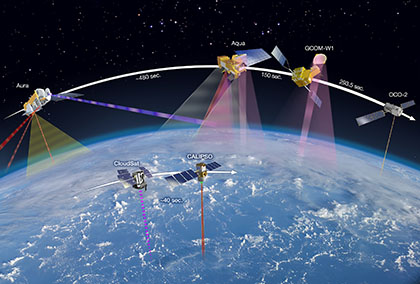
The international Afternoon Constellation includes the A-Train satellites (OCO-2, GCOM-W1, Aqua, and Aura) as well as the C-Train satellites (CALIPSO and CloudSat).
The Afternoon Constellation is composed of a number of satellites following one another along a “track” in space. While they aren’t literally connected like railroad cars, precise engineering and planning—called constellation flying—allows for them to function as if they were “connected.”
Constellation flying allows the instruments on all of the A-Train and C-Train satellites to function as if they were together on a large extended satellite platform. This means that scientists can use instruments on several different satellites in the constellation to study a particular atmospheric phenomenon of interest—e.g., clouds, aerosols, trace gases—and learn more than they could have with any one satellite by itself.
Combining data from these satellites enables scientists to gain a better understanding of a variety of Earth-system processes, including those relevant to climate. Data collected synchronously gives more-complete answers to important scientific questions than would be possible with satellite data collected at different times.